
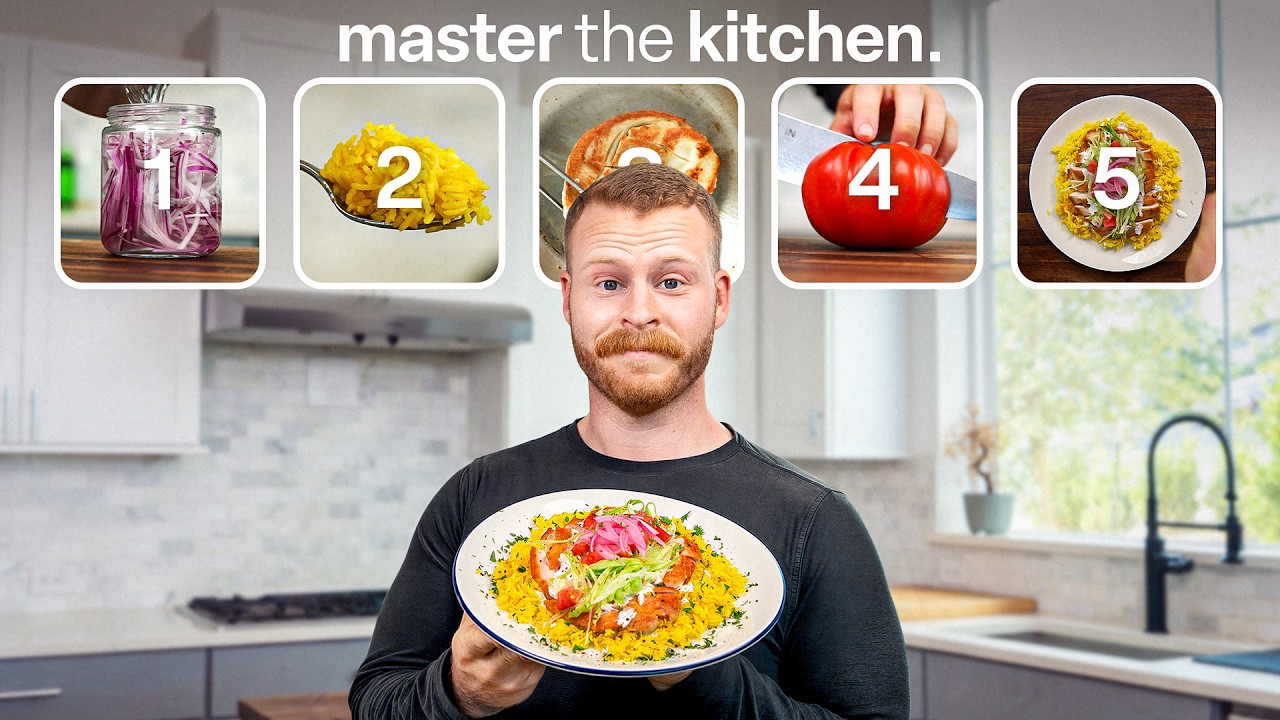
Give me 18 minutes and I will completely change how you cook.
Check out the Carbon Steel Griddle + Press along with my other favorite
cookware from Made In by using my link – https://madein.cc/0726-ethan
Check out the Cook Well app: https://www.cookwell.com/download
Scale options:
– Scale 1: https://amzn.to/4wOspf5
– Scale 2: https://amzn.to/3REBoAM
0:00 Intro
2:04 Q1 – What should this dish taste like?
8:11 Q2 – What is the water doing?
11:06 Q3 – What temperature(s) do I need?
14:47 Q4 – What do I want this dish to feel like?
16:06 Q5 – Is this dish missing anything?
MISC. DETAILS
Includes music by Tom Fox: https://www.tomfox.site/
Filmed on: Sony FX3 & Sony A7C
Voice recorded on Shure MV7
Edited in: Premiere Pro
28 Comments
Check out the Carbon Steel Griddle and Made In’s other cookware by using my link to save on your order – https://madein.cc/0726-ethan
Also what deep dives do you want to see next? I kind of want to do one on peanut butter…
P.S. You may also like our Cook Well app: https://www.cookwell.com/download
yes, peanut butter! I've made lots of African peanut sauce and also SE Asian dishes with peanuts as a base, and of course baking with it in cookies or banana bread, eg. But anything would be cool!
Ethan Ethan Ethan!! 🤯💯💜 this video is a prime example of why I love your channel. The break down is excellent. From beginners to experts, everyone can learn. Continued success to you!
Thats super expressive… if you cant look and see then your over doing it
I love and appreciate your videos but you had me cracking up saying Tempetures over and over hahaha
Excellent angle and video! As a 67 year old accomplished home cook, I applaud your scientific approach to techniques we learned to follow and understand with our senses. For me, the smells of cooking provide another gauge of taste and temp of foods, especially in baking. Cooking is an art and a science. If you can't master the science, it's difficult to practice the art. Thank you for a better training tool. 🙌🏻
I like that starchy stuff can cover up the failures of other parts of a dish. If something was too watery or greasy, or there's too much sauce, starch'll handle it.
holy smokes ethan has rocket league skills omg
Kitchen scales. Plural. Big one and the gram scale. Use them until you're eyeballing stuff and getting spot on or close enough. (Of course, don't discard them after you get to cooking by eye…you'll always use for baking.)
By far the best cooking channel on youtube. There is really no comparison.
This guy is sooo gorgeous 😩
Hey Ethan, I measured my pans temperature with an infrared scanner across different heat settings on my burner. I couldn't believe how many hot and cold spots I had on all my pans. But doing this also help me figure out the best heat setting for my particular burner. And 8 was too cold and didn't produce good mailard browning, while at 10 I scorched everything. 9 was the sweet spot that cooked the food correctly with great browning. And I may have never figured out how important that was if I never measured my pans. Great breakdown on the science!
A 1.25 : 1 ratio of water to rice? I cook on stovetop not a rice cooker and that ratio is 2:1 for white rice, 3:1 for brown rice, and 3.5:1 for wild rice. Maybe it's true for a rice cooker because I don't own one to know, or maybe it's for the converted parboiled rice in a box. Oh, and don't take the lid off white rice while cooking. That makes it mushy. Just bring water and white rice and dash of salt to a boil, stir once, put lid on, reduce heat to simmer, and cook for 12 minutes. Don't take the lid off just to look. If it starts to bubble over, just take the pan off the burner for 10 seconds, then place back on burner continue cooking and next time turn your burner down a little more because your first simmer setting was too high.
10:35 water management / meat. You say water on the surface of the meat. Ha! It's more like how much water was injected into the meat by the grocery store or meat processor to bulk up weight. Butcher shops not so much.
There is actually a DVD course with very close to this material in even more details. It's available at my library. The Great courses: the everyday gourmet, rediscovering the art Lost art of cooking. Chef Bill briwa. It walks you through balancing flavors and each main cooking technique.
The proper answer to "What should this dish taste like?" is evident only after you've cooked hundreds of dishes, many of them suboptimally.
Is The cooking goat also a double tapper on Rocket league? Thats a double win for a cooking lover and a salty RL player as i am
This is like your 20th video about mixing pickled onions with salt and lemon juice to achieve balance, I simply cannot and will not watch any more.
Dill anything damages food .there are more than 5 flavors or dill would not be terrible.
I know I haven't watched enough of your videos, but is that cameo at 16:57 the first we've seen of your pup?
Also, what kind of oil are you using with the chicken?
That moment when the “Jeff Nippard of cooking” uses lifting footage and REP fitness urethane equalizers at that. Good choices of home gym equipment!
Not you talking about how we dint teach techniques while showing The Professional Chef the gold standard textbook forevery culinary school
🤭
As a physics guy, I think you would be really good at covering the topic of heat vs temperature. Your question "what temp do I need" would be better phrased "what heat do I need" because a 375F frying pan is very different from a 375F oven or a 375F deep fryer.
Best youtuber influencer out there. Better than all other food fluencers. With exceptions of Fallow, and Adam not raguesa .the British chef.
I am talking Josh, The italian american guy , notorious foodie etc.
At least Ethan's style is what i like because i learned a lot by myself by expeience, reading, watching, etc.
A risk with the last question is you might end up making all dishes the same, with the mindset that every dish should have all the flavors and all the textures and all the temperatures and whatnot.
How much salt?
1 teaspoon per quart for soups and sauces.
2 teaspoons per pound for boneless raw meat.
1 teaspoon per 4 cups flour for dough.
1 teaspoon per two cups liquid for cooked cereal.
1 teaspoon per 3 cups water for boiled vegetables.
5% salinity for meat brine.
1% salinity for pasta water.
0.6% salt for NY pizza sauce
0.8% salt for Neapolitan pizza sauce
1 tsp kosher salt = 4.8 grams
1 Tablespoon coarse or kosher salt = 2.5 teaspoons table salt.
Just be careful with no 5 when related to food cooked by others… 😅
Two huge tools in my cabinet:
1. Thai mushroom soy sauce
2. Chinese black vinegar