
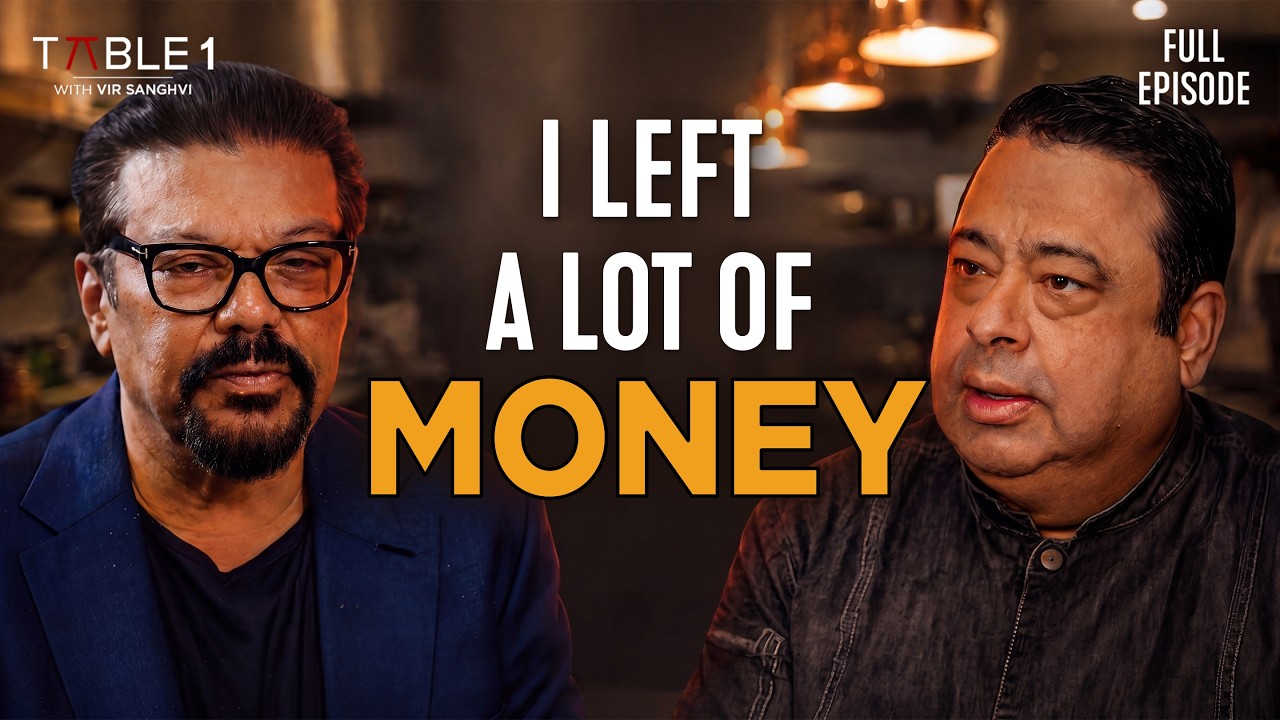
Manish Mehrotra: Empty Restaurants, Leaving Indian Accent & Starting Over | Table 1 with Vir Sanghvi
Before Indian Accent became one of the most celebrated restaurants in the world, diners were walking out.
Manish Mehrotra joins Vir Sanghvi on Table 1 for one of the most candid and deeply personal conversations of his career. In this episode, he opens up about the early days of Indian Accent when diners rejected the menu, the relentless pressure of staying at the top of global fine dining, and what drove him to walk away at the absolute peak.
He speaks openly about failure, risk, and the cost of success. From being dismissed in the early years to redefining modern Indian cuisine, Manish reflects on the decisions that shaped his journey, including leaving behind financial security and the profound personal heartbreak that changed his entire perspective on life. He reveals the thinking behind his iconic dishes, the wildly successful launch of Nisaba, and drops news on his next venture.
This is a rare look at what it truly takes to build, sustain, and walk away from a legacy. A brutally honest story of one of India’s greatest chefs.
Table 1 with Vir Sanghvi, produced by Culinary Culture Studios, brings together influential chefs, restaurateurs, hoteliers and hospitality leaders for honest conversations about ambition, failure, risk and the realities behind building successful empires.
Watch the full episode and subscribe for more conversations from Table 1.
00:00 – The Disastrous Opening of Indian Accent
07:08 – “People Walked Out”: Surviving the Early Failures
10:45 – The ‘Foodistan’ Turning Point
16:40 – Inventing Modern Indian Cuisine From Scratch
26:14 – The Unseen Pressure of Perfection
32:19 – The Devastating Personal Loss That Changed Everything
38:21 – Walking Away at the Absolute Peak
45:51 – Building Nisaba & Starting Again at 50
51:35 – Serving Chips & Ice Cream on a Fine Dining Menu
58:56 – Taking Indian Street Food to the Global Stage
1:01:16 – The Future: His Next Restaurant
1:02:32 – His Legacy & The Chefs Who Will Succeed Him
FOLLOW US:
Instagram: 📸 https://www.instagram.com/culinarycultureco/
#Table1Podcast #ManishMehrotra #VirSanghvi #CulinaryCulture #HospitalityIndustry #FineDining
14 Comments
He walked away from money at the peak of his career. Would you have the courage to start over at 50, or would you have stayed? Let us know down below! 👇
❤❤🎉🎉
It is not fair on Vir Sanghvi’s part to not treat Manish Mehrotra with respect . Manish is without doubt the greatest chef in India today. Would Vir treat Vikas Khanna like this? No . Is it because his fluency in English is not to his liking ? Or it because he come from Patna ?
For the information of Vir & Manish . Champaran has always been famous for the quality of its goat meat coming from “Black Bengal Goat”. Champaran meat was famous not because of its cooking style but for its Black Bengal Goat meat quality due to the feeding at local pasture and water from Gandak river .
So i wasn't the only one to notice Vir's grim, lack of interest n almost condescending attitude..
I wonder why 😮
Such a raw and beautiful episode ❤
Waiting for episode with zorawar Kalra ❤
great story …👌🙌👍🔥 amazing watch
Watching this podcast only a few days after Mark Wein's visit to Nishaba and Manishji's hosting with his signature dishes was truly a great experience.
A masterchef australia contestant two seasons ago made chips and ice cream which the judges loved!
Comorin is Kanyakumari. cape Comorin is the southernmost tip of mainland India . I thought the restaurant was named because of that . 😅
The region of Champaran (in Bihar) has long been known for high-quality goat meat (mutton). Locally raised goats there are valued because:
* They’re often free-grazing, feeding on natural vegetation rather than commercial feed
* This leads to leaner, firmer meat with stronger flavor
* The animals are typically smaller and younger, giving more tender cuts
So historically, traders and locals prized the raw meat itself, not just any dish made from it.
Goats in Champaran are typically free-grazing browsers, not stall-fed.
* They eat shrubs, leaves, herbs, and tree bark (not just grass)
* Many of these plants contain aromatic compounds (terpenes, phenolics)
* These compounds get deposited in fat and muscle → more complex, “gamey” flavor
At Vineet Bhatia’s Zaika in London the food was delicious.
Mazaa aa gaya. Koi affordability wala chef bhi lao show pe bhai.