
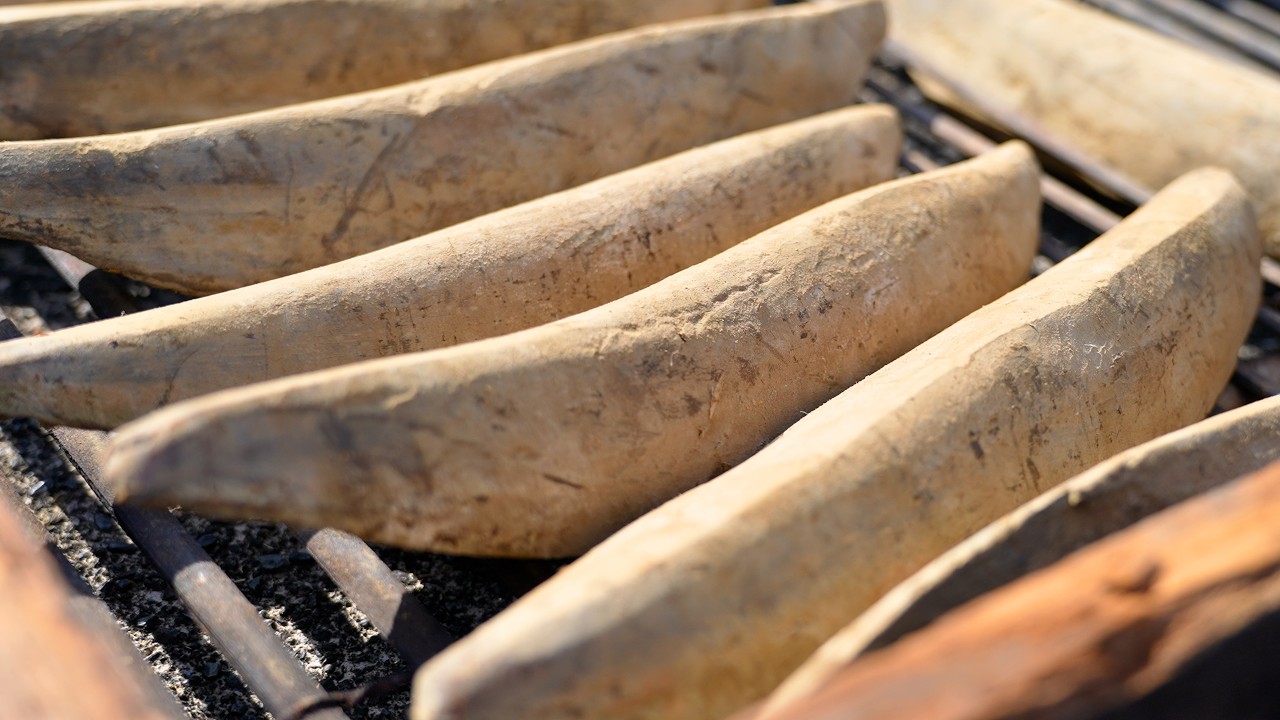
How the World’s Hardest Food Is Made: Traditional Japanese Dried Bonito, Katsuobushi
How katsuobushi — Japanese dried bonito, said to be the world’s hardest food — is made in Nishi-Izu, Japan. Inside Kanesa Katsuobushi Shoten, a workshop founded in 1882, 5th-generation craftsman Yasuhisa Serizawa still uses the 200-year-old “tebiyama” hand-fired smoke-drying method that only a few workshops in Japan preserve. Watch fresh bonito being filleted and boiled for 90 minutes, smoke-dried more than 10 times over a hand-tended wood fire, repaired with bonito paste, fermented with koji mold and sun-dried for months — over half a year until the fish becomes as hard as wood and shines like a jewel. From fresh catch to katsuobushi.
⬇︎Subscribe to our channel!
https://www.youtube.com/channel/UCz7LrNt_1IwEA56mga66zRg?sub_confirmation=1
Kanesa Katsuobushi Shoten (Nishi-Izu, Shizuoka)
MAP→https://maps.app.goo.gl/C1q3p8Z6eSApZeYp6
WEB→https://www.canesa.net/
Instagram→https://www.instagram.com/kanesa168
Japanese Restaurant Ajimasa
MAP→https://maps.app.goo.gl/FTq7DoVcA5vuNGNR6
00:00 Intro
00:21 Yaizu Port — Frozen Bonito
01:33 Thawing the Bonito in Water
02:22 Filleting the Bonito
04:54 Special Knives for Processing Bonito
05:13 Boiling the Bonito
07:10 Removing the Bones by Hand
07:56 Smoking the Bonito to Dry It
11:33 Japanese Noodles with Bonito Dashi
13:41 Wasabi Rice Bowl
14:27 Repairing Cracks with Bonito Paste
15:54 Sun-Drying
17:28 How to Shave Katsuobushi
↓Join our Discord server!
https://discord.gg/Cm73jKAf4u
↓Please support our channel by joining our membership!
https://www.youtube.com/channel/UCz7LrNt_1IwEA56mga66zRg/join
↓The process of the Japanese Products channel is here!
https://www.youtube.com/channel/UChzbJzVd453Kwsp04RXuhFw?sub_confirmation=1
↓Our travel channel is here!
http://www.youtube.com/channel/UCTBYZxS4p-RnMcihOJUWMng?sub_confirmation=1
We want to share the charm of Japan through Japanese food videos.
We will deliver videos that will be useful to people who are traveling to Japan, so please subscribe to our channel!
(Subtitles are available in 14 languages — please turn on CC!)
#Katsuobushi #Shizuoka #JapaneseFood
25 Comments
Un travail conséquent avec un goût indescriptiblz, ça c'garder la tradition
I was not expecting the fish to be boiled
가다랑어가 맛있다는 걸 알지만 만드는 과정은 너무 비위생적인 거 같네요. 관계기관에서 위생관련 점검하지 않나요? 영업정지 당할거 같은데 ㅎㄷㄷ!!!
일본의 음식문화는 멋지고 역사도 있는 귀한거라 알고 있지만 만드는 과정은 너무 더러워 보입니다.
Es muy bonito
왜비위생적으로보이지
"Do you feel bonito?"
"Yes, I feel bonito…"
This dudes a total legend for sharing his craft with the world and doing it for the absolute love of the game.
Japanese people are the best in the world at everything. Super-ultra-duper good people.
It’s sad these incredible traditions are fading away. One day the taste of hand dried bonito will be a distant memory. I truly hope craftsmen like these keep these traditions alive
鱼类加工,而且是室外,整个视频都没看到苍蝇,卫生怎么能做到这么好。
To say this is labor intensive would be putting it mildly!
We have a identical food in southern India, srilanka, and other neighbouring islands. We call it "Maasi fish". Absolutely addicting to eat.
Honestly. Id love to learn and do this,
cant ship the Katsuobushi to the US 🙁
I love how this is still mostly done all by hand. Each person has a job there and isn't being replaced by machine. Each item is handled with care which is why Japan has some of the best products/quality in the world.
I'm amazed that the fish doesn't lose flavor and integrity after all that boiling, I thought it would've been dried unprocessed
헉 정성…완성된 가쓰오부시는 보석같네 정말
Japanese knives are best in the world
Can someone explain why it is necessary to use the paste?
와… 진심으로 먹어보고 싶네요
Ok, I was wildly wrong. All these years I thought bonito flakes came from crustaceans. Maybe because I first encountered shrimp flavored bonito flakes? I genuinely had no idea it was a fish.
Either way, was a very cool learning experience. Thank you for the upload.
Move over, hard tack.
Veíamos una serie muy linda, restaurante de media noche , y al final de cada episodio daban la receta, yo decía , que locos estos japoneses comen viruta. Cero en gastronomía japonesa.😁
Food workshops with such hygiene condition will be prosecuted in China.
The more you know. I thought it was a type of root not a fish.