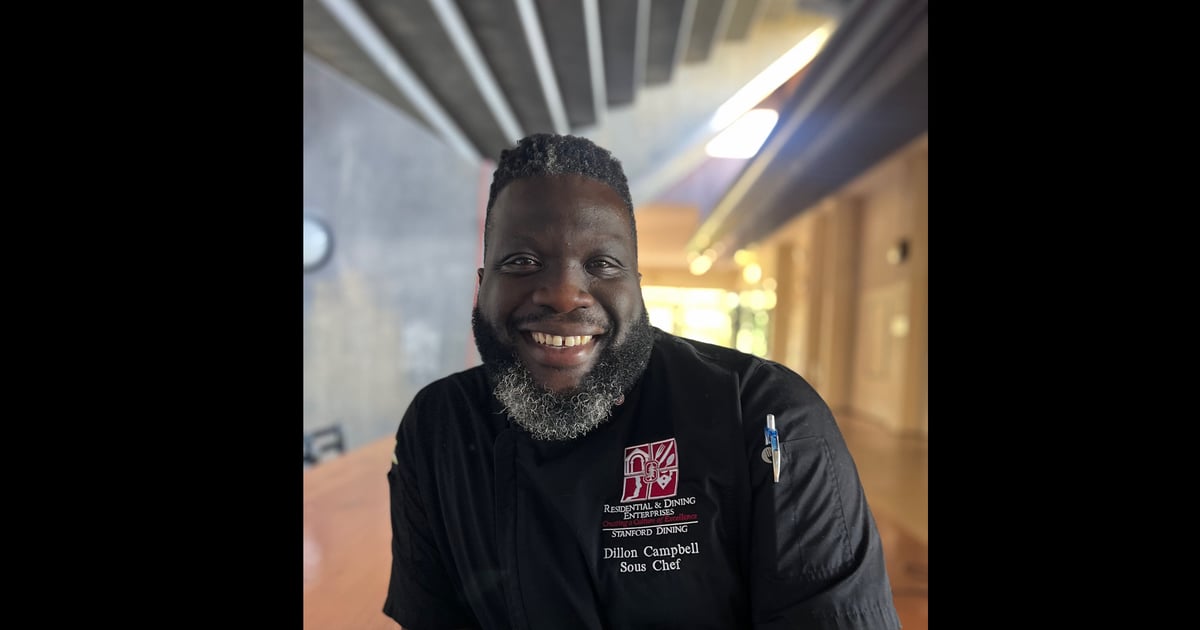
For Dillon Campbell, a sous chef at Stanford University, cooking has been an interest since he was young.
“Food has always been a passion for me,” he says. “I’m originally from Jamaica, so we’re very big when it comes to cooking.”
Like many chefs who currently work in college and university dining, Campbell didn’t start out there. Instead, he began his career working at an all-inclusive hotel and in fine dining.
His first brush with noncommercial foodservice was working in Apple’s corporate cafeteria for several years. He then made his way to Stanford. Today, he works at the busiest dining hall on campus, which serves around 2,500 students daily.
Stanford draws students from all over the world and one of Campbell’s favorite things about working at the university is preparing international students’ favorite foods from home.
“You talk to a person from the other side of the world and they tell you, ‘Oh, I miss my mother’s cooking,’ and I’m like, okay, I’m going to try and make what your mother used to make you,” he says.
Campbell also takes the opportunity to serve a taste of his home to the students as well.
“I try to bring a little bit of the Caribbean as much as I can,” he says. “A lot of jerk chicken and braised oxtails.”
Menu planning is well underway for next school year, and Campbell is currently working on some vegan recipes that focus on fresh, healthy ingredients.
“We try to just work with more vegetables. You know, try to get people to eat cleaner, just a little bit healthier,” he says.
Campbell is also looking forward to attending FoodService Director’s FSD Chefs Immersion West Coast held next month at the University of California, Davis (UC Davis).
The three-day event, which is sponsored by The Almond Board of California, Choolaah Indian BBQ, BelGioioso Cheese, Fresh Concepts, Hormel Foods, J.T.M. Food Group, Mondelez, and MOWI, allows attendees to learn from their fellow noncommercial chefs and get creative in the kitchen.
Campbell is excited to see how the dining program at UC Davis runs and hopes to bring back some ideas he can implement at Stanford. He also looks forward to connecting with the other chefs.
“It’s a big field, but it’s also small at the same time, so let’s just build bridges. We’re not competing with each other,” he says. “We should be building a culture of chefs and creating new ideas.”