
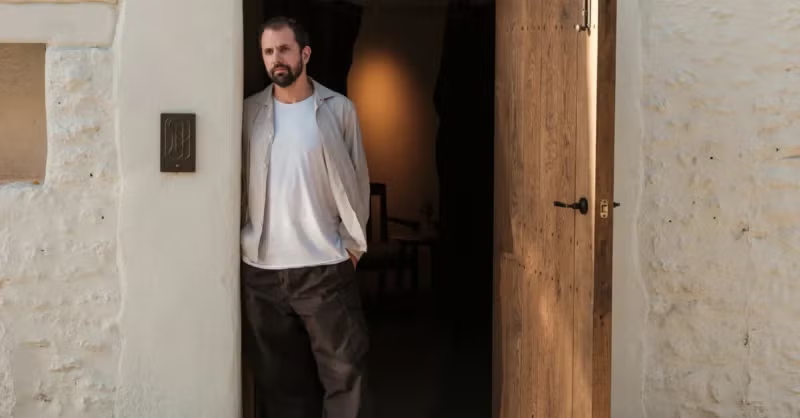
He’s a little shy, Mr Kashisa, and very humble — but he is, I will learn, one of the last people in this part of the country who knows how to build in this way. He created the traditional wooden tea house nearby that is so immaculate, I knew once I stepped in it that I wanted to come and see his work.
I take a beat and cast my eyes around the workshop. I take in the tall ceilings and the smell of hinoki wood, and ask myself the question that will trail me for the next fortnight: why does this move me so much? I had come to Japan, ostensibly, to look at craft in general. By the time I left, I realized I had been looking at my own.
I’m a chef. My restaurant, Osip, sits in a quiet corner of rural Somerset in the southwest of England, and craft runs through everything we do there — from the food to the hand-carved spoons that diners use to eat agnolotti. Japan is where I go to step outside all of it and think.
This was my second visit. The first, three years ago, arrived with a force I hadn’t anticipated and rearranged a great deal of my life — my approach to work, my philosophy on cooking, my interest in design. I came home determined to make the trip a yearly ritual: a way of beginning each January quietly, in a place that runs at a gentler pace than the one I keep at home. Everyone detoxes in some fashion at the start of the year; this is mine.
See also: The Japanese Island You Should Be Visiting
Reinstating the ritual took longer than I’d hoped. For the past two years I’ve been building and then opening Osip ‘2.0’ — the second incarnation of the restaurant, which we moved from its original home in a boutique hotel to an 18th-century farmhouse that is entirely our own. This winter was my first chance to go back to Japan and, I suppose, a reward for bringing the next chapter of Osip into being.
What is it, exactly, that I find there? A minimalist instinct that’s very satisfying, for one thing. A sense of precision, for another, plus a deep respect for, and dedication to, traditional crafts. But all these things sound a little neat and reductive when you write them down. I admire Japan’s cultural respect for craftsmanship — the Japanese have a way of stripping life and work back to what is essential and then attending to that with enormous care. Even the smallest task is treated as purposeful. Buy a trinket, or just a sandwich, and watch the way it’s wrapped: the Western part of my brain is shouting ‘hurry up,’ and the rest of me is quietly thinking ‘but this is beautiful.’ There is a reverence for ordinary things that I’ve tried to emulate in my own life for years.
So, this time I shaped the itinerary around that idea. I wanted to find makers I might one day work with at Osip, where craft underpins our approach, from the aformentioned spoons to the produce we grow and prepare. But I also wanted to test a private theory. We had recently staged a craft exhibition at the restaurant, and in talking to the makers who contributed I’d noticed how little distance there is between what they do and what I do. Hand-turning a bowl is not so far from baking a loaf, if you’re approaching it in a thoughtful way.
And I’d had another thought: that the Japanese ryokan, the traditional country inn — small, owner-run, devoted to its food, its farmers, its community, and its crafts — is more or less what we are trying to be in the English countryside. I wanted to go with that in mind and see where it led. I flew into Tokyo with my partner Olivia, and we were promptly flattened by jet lag, losing two days I’d earmarked for the fish market and the antique shops.
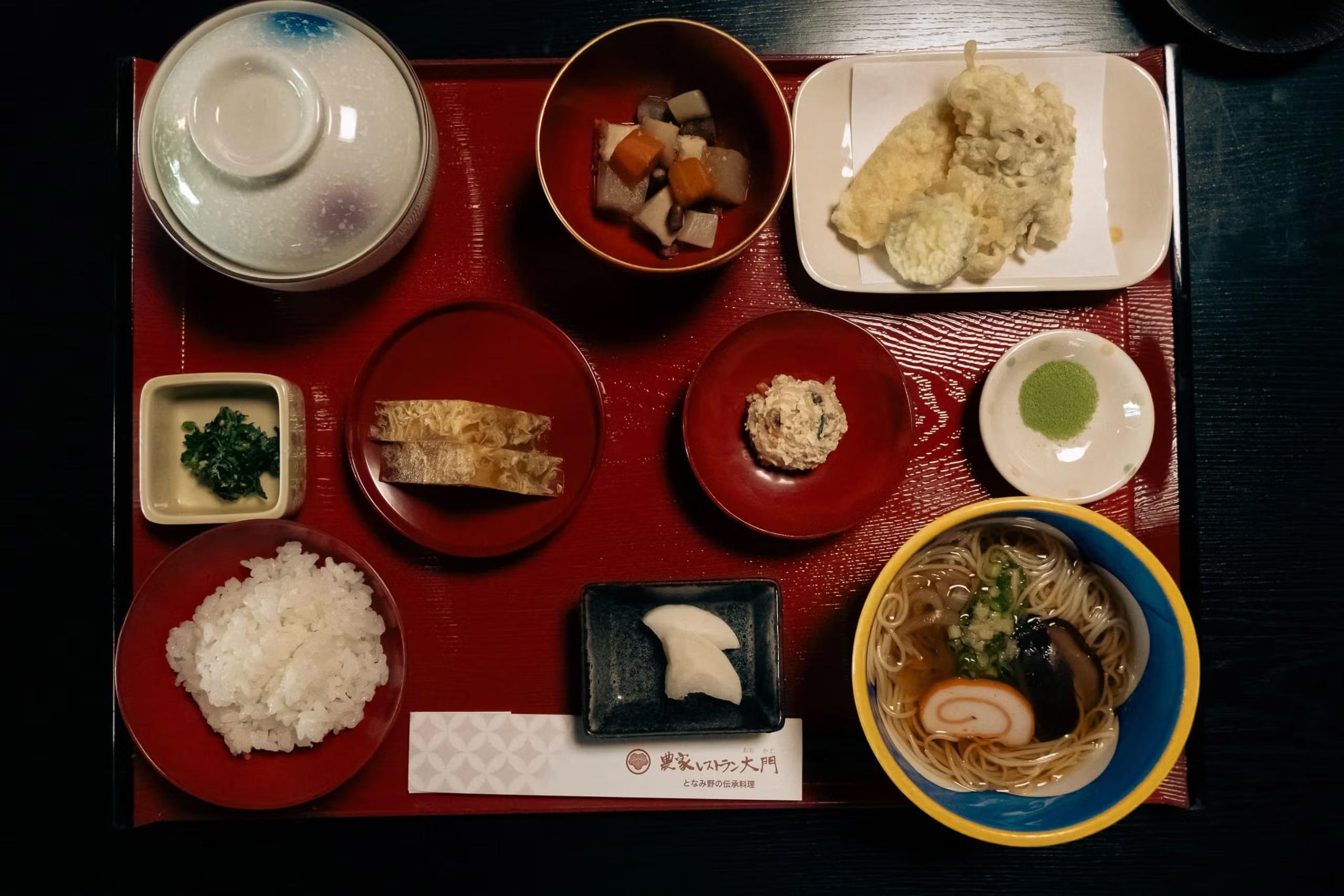
From the city we went to Ishikawa, on the snow-country coast, and to Hanamurasaki, a ryokan in the onsen village of Yamanaka. Its owners are a young couple, Kohei and Manami Yamada, who had themselves visited Osip and although I had booked a room, they insisted on hosting us in a kind act of generosity — driving us out to see the makers and arranging everything personally.
Kohei had been studying photography in San Francisco when his father died suddenly and the ryokan passed to him; he runs it now as a place where high-level food, hospitality, and craft fold into one, with a small gallery on site. We bathed in the village’s hot springs and participated in a tea ceremony. It was, I kept thinking, the thing I’d come to find: a house run by people who cared about everything, all at once.
The visits began with a trip to Fukui to visit a knife maker called Yu Kurosaki — said to be among the most revered in Japan, coveted by the world’s best chefs, though I confess I’d never heard of him before. His workshop was nothing like the smoky, dustcovered forge I’d imagined; it was contemporary, clean, surprisingly airy, and everything had a place. I watched Kurosaki take a length of steel from the fire, white-hot, and briefly malleable, and hammer it into a blade. It was 10, 15 minutes of complete focus. There is no machine that can do what he does. It’s entirely a matter of touch; of a body that has done a thing 10,000 times.
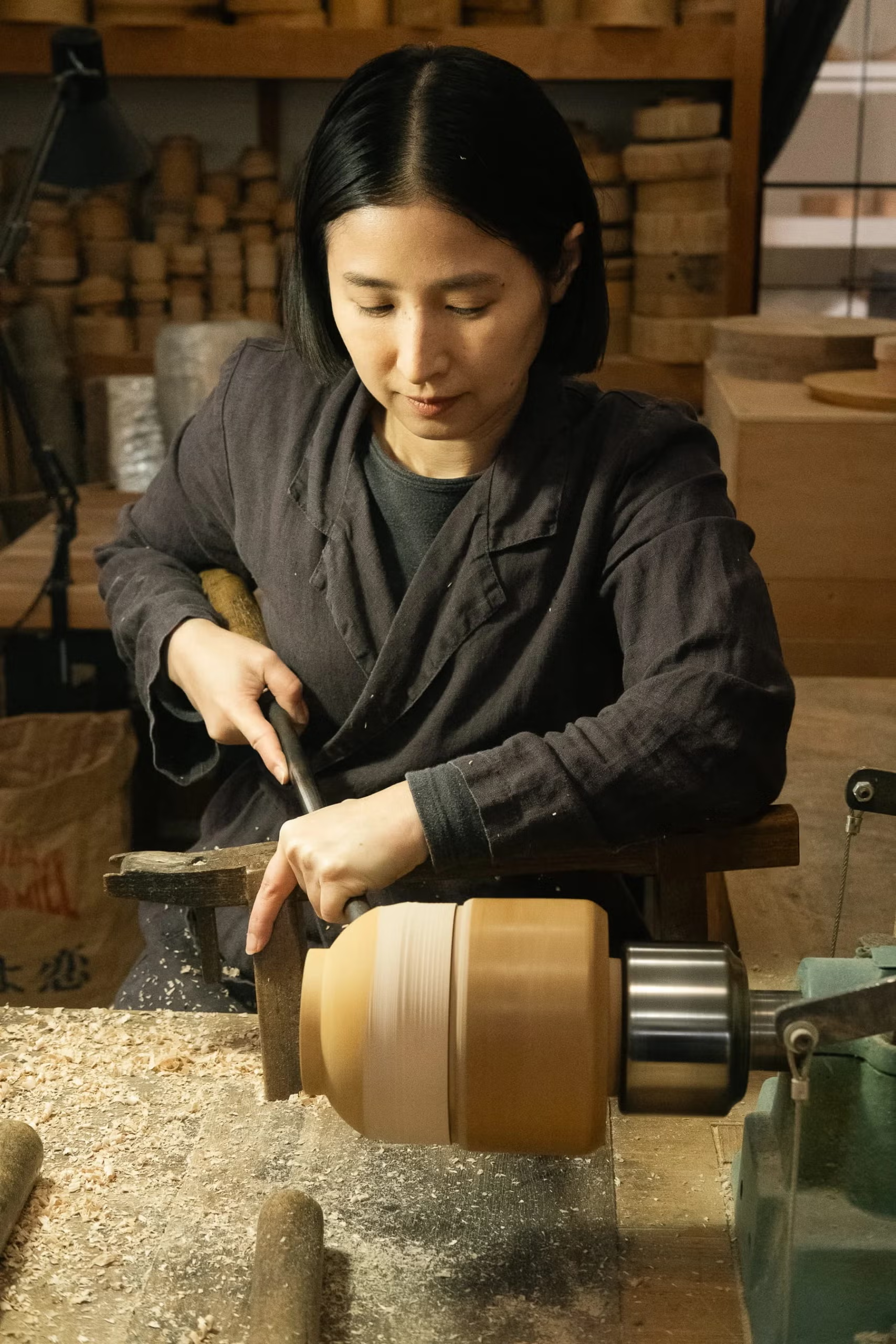
Kohei and Manami also took me to a kiji-shi (traditional woodturner) called Mako Yamada, who worked alone in a small, peaceful studio, finishing bowls and plates with lacquer drawn from the sap of the urushi tree. Her work was exquisite, but what struck me most was that she existed at all: woodturning here is traditionally a man’s trade, handed from father to son, and she is a first-generation woman in it. She spoke no English, but you could sense her dedication and the meditative approach she applied to her work.

In Toyama, the next prefecture along and a region famous for working metal, I visited Shimatani Shoryu Studio, the domain of a man called Yoshinori Shimatani, who is one of perhaps four or five people left in the whole of Japan who can still make the bronze bells used in temples.
To do it you must be an incredible metalworker, of course, but you must also learn to listen — tuning the bell by ear as you shape it, an act that takes 20, 30, 40 years of attention before your ear can be trusted. Shimatani learned from his father and his grandfather, and he suspects he is the end of the line. He makes hammered tin vessels too, perched on a tree stump of miso soup.
Again and again, we heard the same words: “I don’t know if anyone will take this on. The work is hard and unglamorous and it doesn’t pay. We have all grown used to things that are cheap and fast and thrown away.”
With this refrain playing on my mind, something clicked. The word ‘mingei’ — Japanese for ‘folk craft’ — kept surfacing, and I realized I’d already read the book that founded the movement, The Beauty of Everyday Things by Soetsu Yanagi, some years ago. The concept had been percolating, almost unconsciously, in the back of my mind. It’s always troubled me that craft has never carried the prestige of fine art. But it is, in its own way, just as beautiful, just as important and increasingly rare. Nothing made this plainer than our visit to a near-abandoned hamlet called Ozuchi, in the mountains of Ishikawa. It was just with a groove hollowed into it that helps the vessels take shape slowly.
Not all of it was so solemn, though. At Nousaku, a larger tin foundry, they sat Olivia and me down and let us try our hands at hammering out our own beakers. I’d like to report that some latent talent revealed itself. It did not — Olivia’s were considerably better — but there is no better way to understand a craft than to be humbled by it for 10 minutes.

In the time we spent traveling through the two prefectures a melancholy pattern emerged. Almost everyone I met (with the refreshing exception of Mako Yamada) was the last of something: the bell maker; the carpenter; the father-and-son kelp house in Toyama who supply their kombu to Noma, and who talked me through dozens of grades of seaweed for two hours over a bowl eight or ten old wooden houses and a single remaining inhabitant, a man of about 60 who has appointed himself its steward. He grows his own rice and vegetables, keeps a cat, and clears the snow from the roofs each day so the houses don’t collapse under the weight of winter. In season, volunteers and students come from across Japan to help him.
I found it bewildering that anyone would leave somewhere so beautiful, and there’s a real pathos to be found in the inhabitants of the village slowly leaving, year by year, or decade by decade, to find new lives in urban Japan. It’s equally moving to reflect on that single man, self-appointed guardian of the hamlet, who decided to stick it out with only a pet for company — out of a sense of duty he clearly feels to where he comes from.
Wakayama, when we reached it, was a reprieve. I went to see a sansho-pepper farmer, a one-man operation run by Yusuke Shinohata, who’s roughly my own age (35) and who grows, harvests, processes, and sells himself, and who now supplies two restaurants in Britain: Ynyshir in Wales, and us. Sansho belongs, surprisingly, to the citrus family and there are almost no young people left growing it. Shinohata is another outlier, but one who feels less sad and more hopeful, given his relatively young age.
We ate, on that leg, an incredible meal at Villa Aida, a two-Michelin-starred restaurant that is really just a house. Chef Kanji Kobayashi — a friend who worked with me at Osip last year and was recently named chef of the year in Japan — does all the cooking. His wife does the serving and together they tend the garden that feeds the kitchen. There is one table. Lunch is meant to run for around four hours; ours ran for nine, helped along by several bottles of wine. So many of Kobayashi’s dishes were incredible, but there’s one I still can’t quite describe: a multitude of vegetables, each cooked its own way, each with its own sauce and herbs — a riot of color and freshness.

Wakayama is one of the warmer regions in Japan and the couple grow things like strawberries, even in January. It was inspiring to eat that kind of food in the middle of winter. The last maker I saw was a charcoal burner, again father and son, producing binchotan (a particular kind of charcoal) in a kiln they had built themselves from mud and clay. The wood burns for 14 days, almost without oxygen, to create charcoal that is smokeless, ferociously hot when it burns, and exceptional to cook over. It’s also close to carbon-neutral, since they plant as they harvest and take only the trees that crowd out the rest.
We intended to visit Kyoto but never made it in the end; the snow swallowed a day and we turned back to Tokyo, to a last bout of flea markets and to Kappabashi, the city’s ‘kitchen town,’ where I filled my suitcases with knives, steamers, and the kind of strange, perfect utensils you find nowhere else.
Why, though, at the end of a fortnight of exploring, learning, breaking bread with friends and mourning for passing crafts, does all this matter to me so much? I think it’s this. What I respond to in a hand-sharpened knife or a simple turned bowl — the human touch, the slight, lovely irregularity of a thing made by a person rather than a machine — is exactly what I value in the kitchen.
For years I have said that Osip is more than a restaurant. To me, it is a place where craft, farming, design, and food all meet, and I have never quite found the words for it. Two weeks among people who live that idea without needing to explain it gave me the language and helped everything make a little more sense. Which is, I suppose, the most you can ask of a journey. Not to be changed, exactly, but to have the ideas in your head shaped and honed till they slot, finally, into place — like a carpenter whittling away at the perfect wooden joint.