

CRESTED BUTTE — Most Sundays, chef John Leonardi goes to Hotchkiss. Earlier this summer, he got some bad news during one of his trips.
The tomato plants were dead at Thistle Whistle Farm, where Mark Waltermire has been growing specialty produce for farmers markets, a small CSA, local chefs and nonprofit partners since 2006. That posed a problem for Leonardi, who uses many of Waltermire’s juicy heirloom varieties on the summer menu at Soupçon, his tiny Crested Butte restaurant.
After Leonardi’s initial disappointment, the conversation quickly turned to what was still growing.
“Mark said nonchalantly, ‘there’s no tomatoes this year. Something happened, and I don’t think I have a single live plant in my entire farm,’” Leonardi recalled. “But then he said, ‘I got peppers.’”
So Leonardi bought some Manganji peppers, a Japanese variety Waltermire was experimenting with for the first time, and drove back to Crested Butte to figure out how to cook with the tender, sweet chiles.
That’s how Leonardi thinks about buying from local farms.
While Soupçon doesn’t advertise itself as a farm-to-table restaurant, Leonardi is committed to putting local food on the plates of diners at his nine-table restaurant, housed in a snug mining cabin in a downtown Crested Butte alley. More important than the phrase, he says, is the relationship — and the flexibility.
True farm-to-table, in his view, requires both sides to give up a little control. The farmer can’t promise the chef everything he wants. The chef can’t promise the customer the same thing all year. And the customer, ultimately, has to accept what’s in season — and that one crop can have a better year than another.
“Mark’s tomatoes all died, but he has peppers and potatoes,” Leonardi said, “so it’s like, ‘How do I use peppers at a volume that puts money in his pocket? What can I do now to get his tomatoes next year?’”
The answer, at least this year, was to buy whatever else Waltermire had growing.
Waltermire wasn’t the only North Fork Valley farmer whose plans were upended by forces of nature this season.
About 6 miles west of Thistle Whistle, Ela Family Farms lost its entire fruit crop after a catastrophic freeze in mid-April obliterated every cherry, peach and nectarine fruitlet on the trees. The Ela family quickly pivoted, putting more resources into growing — coincidentally — heirloom tomatoes in high tunnels on their orchard. Those tomatoes weren’t Leonardi’s first choice, but last summer, he was particularly excited about Ela’s apples.
So this year, Leonardi is buying Ela’s tomatoes because he hopes his support will help the farm weather an appleless year — and ensure those apples are back on his menu next fall.
“It’s like with Mark, ‘What do we need to do in order to keep them in business?’” he said. “Next year, I still want apples, so what do I do to support them now so I can get apples next year?”
As Colorado’s farmers and producers increasingly contend with unpredictable weather, water shortages, pests and disease, a late freeze can wipe out an orchard and a virus can take out an entire tomato crop. When that happens, the question for a chef committed to buying locally becomes less “Where can I find another supplier?” than “What else do you have?”
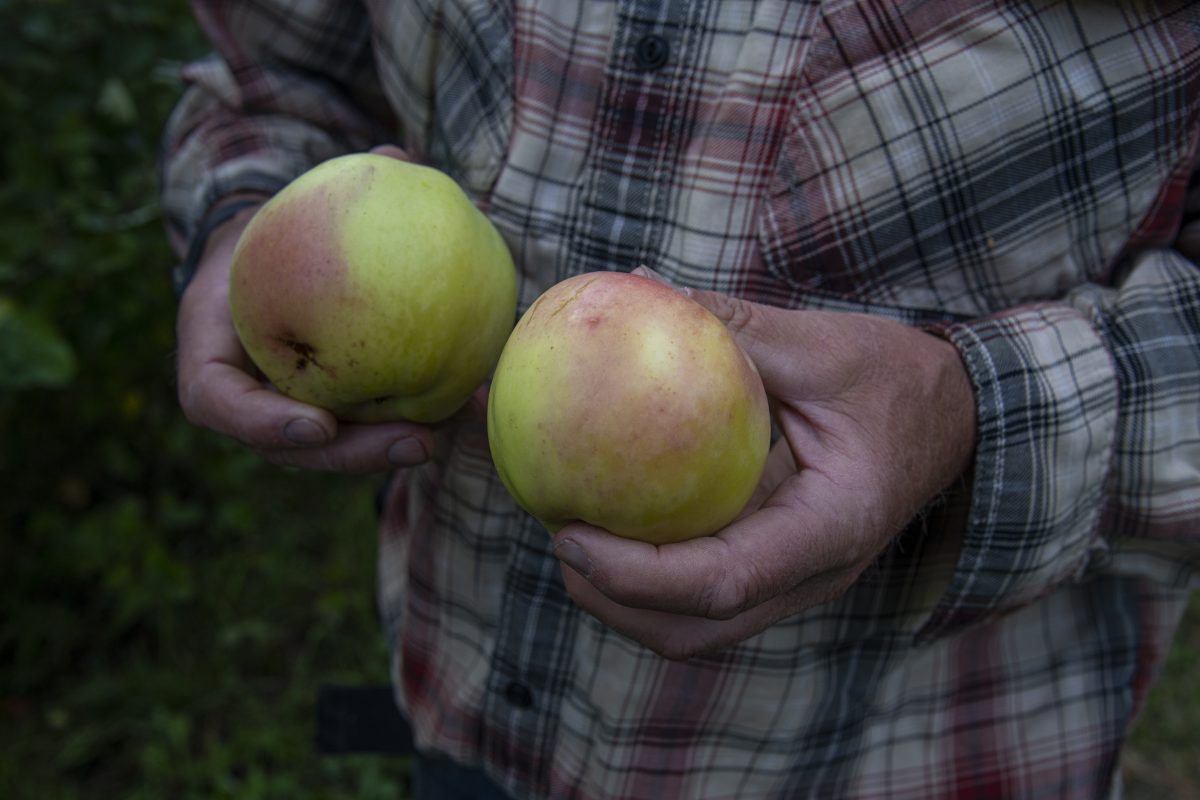 Steve Ela of Elk Family Farms harvests heirloom Colorado Orange apples grown in a small plot on his family’s orchard near Hotchkiss on Sept. 26, 2024. (William Woody, Special to The Colorado Sun)
A different kind of supply chain
Charles Ford has spent nearly five years building Tiny Pine Bistro in Carbondale around that question.
Getting there took time, however. When Tiny Pine opened, Ford didn’t yet know all the farmers around him. His first relationship was with Felix Tornare of Milagro Ranch, who stopped by the restaurant to see if Ford needed meat. Over several seasons, Ford built relationships with other ranchers and growers, visited farms, and became a regular at Carbondale’s Wednesday farmers market.
Now, during peak growing season, Ford estimates that roughly 75% of his $4,000 weekly food budget goes to Colorado producers. It’s a significant financial commitment, particularly at a time when restaurant margins are thin. But for him, the calculation isn’t just about the price of an individual tomato or a dozen eggs.
“Throughout my career, the best definition of farm-to-table is doing what you can with as many people as you can,” Ford said. “It’s your obligation to do what you can in every way to support what’s right around you.”
For Harper Kaufman, who started Two Roots Farm in Basalt in 2015, those restaurant relationships have been part of the business from the beginning. Today, restaurants account for roughly 25% to 30% of Two Roots’ sales, she said.
Ford has been buying from Two Roots for years. His willingness to use whatever is coming out of the field helps guarantee business for Kaufman even when things don’t go according to plan.
“The chefs that we work with are very excited to work with what we have in abundance at that time,” she said. “They’re adaptive depending on what’s available.”
That might mean a chef takes a different variety of greens than originally planned, Kaufman said. Or that an ingredient is available for only a few weeks, like garlic scapes in the spring, and disappears until the following year.
The relationship works in the other direction too. Each winter, Kaufman meets with restaurant staff to talk about what they want to see during the coming growing season. They request certain lettuces and herbs or specific varieties of carrots. The chefs help shape the crop plan, and the farm gives them a market for what it can grow.
More so for Ford, however, the farm dictates the menu. He visits Two Roots’ Friday farm stand outside of Basalt most weeks. Sometimes he knows roughly what is coming. Other times, it’s a surprise: Like the time Kaufman had 16 pounds of baby celery and essentially told Ford he could take it or it was going into the compost pile.
“And then suddenly our salsa had celery in it,” Ford said.
 Chef Charles Ford of Tiny Pine Bistro in Carbondale with a clutch of locally grown onions. “The best definition of farm-to-table is doing what you can with as many people you can do it with,” Ford said. (Betsy Welch, Special to The Colorado Sun)
The ability to roll with those surprises works well at his small restaurant, where the customers have learned to trust that whatever is served will be worth trying.
“The community doesn’t really care what’s on the menu,” Ford said. “They see me and know there will be something good.”
When the field doesn’t cooperate
That flexibility becomes even more important when the issue isn’t an unexpected surplus, but the disappearance of an entire crop, which was the case this summer at Thistle Whistle in Hotchkiss.
As usual, Waltermire seeded his heirloom tomatoes in March, started the plants in a greenhouse, transplanted them to small pots and eventually into the field. He set up irrigation. He weeded, pruned and trellised them. He had about 1,000 plants. By the middle of the season, perhaps half a dozen were still alive.
The culprit was beet curly top virus, which is spread by small insects called beet leafhoppers. Waltermire said the insects can arrive in the region on storms moving north from the Southwest, carrying a virus that affects a wide range of crops.
“Generally, when it’s bad, it kills off a certain percentage of tomato plants and not much else,” he said.
This year was different. The tomatoes were entirely wiped out. The virus also damaged some of Waltermire’s peppers, winter squash, cucumbers, beans and flowers — a wipeout unlike anything he had experienced in two decades of farming. He estimates the losses could amount to 20% to 30% of his income this year.
At Two Roots Farm, Kaufman has been dealing with some of the same problems. Curly top virus damaged her beets, chard, a second planting of beans, winter squash and zinnias. Then came drought, an influx of voles and most recently, reduced flows in the farm’s irrigation ditch, which have forced Kaufman to pump from a pond and conserve water to make it through the season.

I’m irrigating my potatoes with my own sweat right now. This has been a brutal year.
— Thistle Whistle Farm grower Mark Waltermire
Oh, and a bear climbed the fence and ate all of the ripe melons.
Kaufman said this season has brought challenges unlike any the farm has faced.
“Things seem to be getting more difficult in the sense of unpredictable weather and pest pressure,” she said.
Waltermire described a similar shift.
“I’m irrigating my potatoes with my own sweat right now,” he said. “This has been a brutal year.”
Persistent heat and drought have changed the way crops, pests and weeds behave, he said. Winters without sustained cold can allow more insects to survive. This year, his melons ripened three or four weeks earlier than expected. Peanuts — a crop he wasn’t sure would thrive in western Colorado — were doing surprisingly well.
“There’s some serendipitous advantage,” Waltermire said. “But it’s definitely not as predictable as it used to be.”
For Kaufman, growing a wide variety of crops provides some protection. If one crop fails, another might thrive.
“Luckily, we grow so many things that we have some resilience,”she said. “Having relationships that I know I can count on with people excited to support us however they can matter more than ever.”
“You’re the next link in the chain”
Sometimes, the arrangement works in the other direction. Like the time that Ford got a call from Mollie Dooley of Dooley Creek Farm, a meat-and-egg producer on the slopes of Mount Sopris outside of Carbondale.
The farm had slaughtered six pigs, Ford said, but some hadn’t been butchered correctly. Could he take 55 pounds of pork loin off Dooley’s hands?
“I didn’t have that in my Rolodex,” Ford said. “But it’s like, ‘Yeah, let’s do it.’”
In Crested Butte, Leonardi has had similar moments.
A farmer once had 50 pounds of kohlrabi to get rid of. Leonardi took 40 pounds and turned it into a fermented vegetable miso using koji and spent grain from a Gunnison brewery.
Or the winter that he meant to order just enough pink banana squash to make a simple coulis and a miscommunication saw 120 pounds of it land on Soupçon’s doorstep. Instead of the simple squash coulis, Leonardi made a squash bisque with coconut cream. Customers loved it.
“I bought that farm out of pink banana squash that season,” he said. “It was one of those happy mistakes.”
For Waltermire, that willingness to improvise is what makes a restaurant like Soupçon particularly well suited to the kind of farming he does. On his property in Hotchkiss, he grows more than 150 varieties of heirloom tomatoes and close to 200 varieties of hot and sweet peppers, as well as crops that don’t always fit neatly into a conventional market. He grows some because restaurants and customers have shown him there is demand. Others he plants because he is curious about them.
Last year, for example, he planted a few rows of Amarosa potatoes without knowing exactly whether there would be a market. Customers and restaurants loved them, so he planted more this year. But he doesn’t want to grow only what he knows will sell.
“If I grow an African shiso variety, I need someone like John to say, ‘That’s a unique flavor. Let’s see what I can do with it,’” Waltermire said.
The price of local
Of course, this kind of improvisation isn’t always efficient. Ford estimates that buying good local organic food can cost 10% to 15% more than a conventional alternative. Restaurant margins are already thin, and small farms face their own pressure to streamline production and find reliable markets.
Leonardi doesn’t try to hide the fact that Soupçon’s purchasing model makes little financial sense.
“If private equity bought me, they’d shut me down in a second,” he said. “Everything I buy, I overpay for. And we have to pass that on to the consumer. If this is important to them, they’ll pay for it.”
But the additional cost, the chefs argue, buys more than an ingredient. It keeps money circulating locally, gives small farms another market and can sometimes insulate restaurants from disruptions affecting larger supply chains.
“Remember the egg shortage a few years ago?” Ford said. “At Tiny Pine, we were like ‘egg crisis, what egg crisis?’”
Because the restaurant had local suppliers, it wasn’t affected.
That doesn’t make the system immune to disruption. Waltermire’s dead tomatoes made that clear. The economic development nonprofit One Delta County estimates the April freeze caused roughly $15 million in direct agricultural losses for fruit farmers across the North Fork Valley, disrupting not only orchard revenue but also packing operations, wholesale supply chains and businesses that depend on seasonal tourism.
However, the local food system can respond differently to those disruptions. When one farm loses outdoor tomatoes, another might have some grown in high tunnels. When a farmer has too much celery, a chef can put it in salsa. When a crop fails, the chef can buy what survived.
For Leonardi, that’s the point. Farm-to-table is not a straight line from a nearby field to a restaurant plate. It is a web of decisions made by many people along the way: what to plant, what survives, what a farmer needs to sell, what a chef can turn into dinner and what a customer is willing to order.
Sometimes there are heirloom tomatoes. Sometimes there are only peppers. And if the relationship works, the peppers might help make sure the tomatoes come back next year.
Type of Story: News
Based on facts, either observed and verified directly by the reporter, or reported and verified from knowledgeable sources.


