
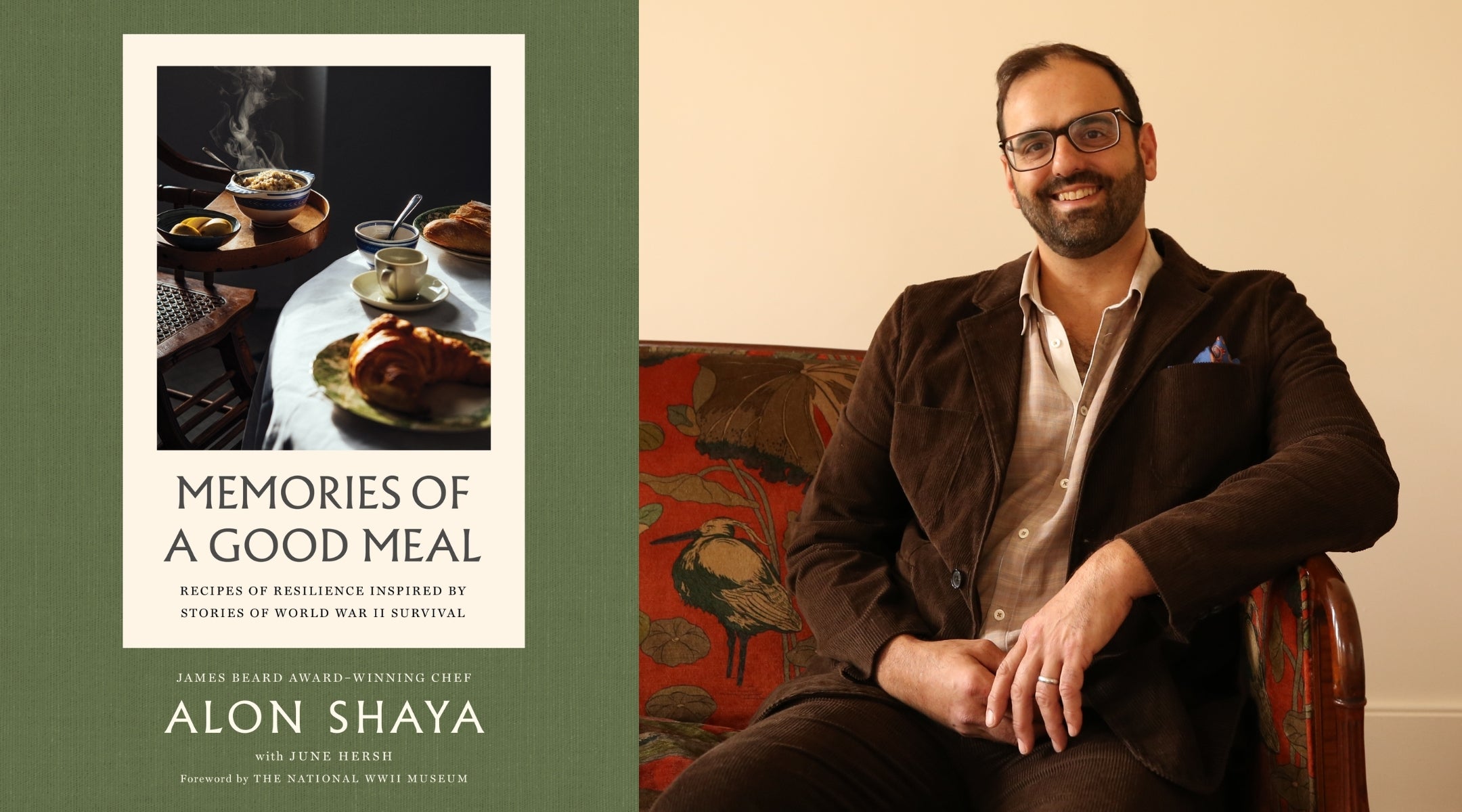
In 2015, while visiting Israel’s Yad Vashem Holocaust Memorial, James Beard Award-winning chef Alon Shaya came face-to-face with a World War II artifact that moved him deeply.
It was a red cloth triangle — cut from a Nazi flag — embroidered with the names of a few dozen female prisoners at the Ravensbrück concentration camp.
In a place where they were starving to death, he learned these women had formed a clandestine “food” club. Together, they talked about recipes, their Friday night Shabbat candlesticks and cherished memories of home.
That red cloth was “100% the catalyst,” Shaya said, for his deep interest in food as “an agent of survival, defiance and bringing people together.”
Now, 11 years after that defining moment in Jerusalem, Shaya’s second book, “Memories of a Good Meal: Recipes of Resilience Inspired by Stories of World War II Survival,” is being published on Oct. 6. Co-authored with food historian June Hersh, the book gathers accounts from survivors and heroes of World War II, illustrating the outsized role that food — and the memory of it — played in human survival. While featuring 80 recipes, it functions as much as a history book as a cookbook.
“The recipes are there to support the stories,” Shaya said. “It’s not the other way around.”
Shaya and Hersh tell the stories of 10 distinct groups impacted by the war, including Jewish partisans, hidden children, Navajo code talkers, persecuted homosexuals, Japanese Americans, and Austrian and German Jews who built new lives in the Dominican Republic.
Alongside these narratives, the authors included family recipes preserved across generations. Where none survived or existed, Shaya crafted recipes using ingredients available to the book’s subjects during the war.
The opening chapter highlights a story particularly close to Shaya’s heart. In 2019, during a visit to the United States Holocaust Memorial Museum in Washington, D.C., Shaya was shown a tattered, 100-year-old, handwritten recipe collection from the Fenves family of Yugoslavia. Saved during the war by the family’s cook, Maris, the Hungarian-language notebook was eventually donated to the museum by survivor Steven Fenves.
Determined to bring those dishes back to life, Shaya worked with Fenves to translate the recipes, filling in missing elements like precise steps, exact measurements and oven temperatures.
 A strip of cloth left over from a Nazi flag was embroidered with the names of women prisoners at the Ravensbrück concentration camp who shared memories of the foods they cooked and enjoyed. The artifact inspired Alon Shaya to write about food, memory and survival. (Yad Vashem Artifacts Collection/Gift of Yehudit [Aufrichtig] Taube, Israel)
“I really became a part of their family,” said Shaya, whose collaboration on what became known as the Rescued Recipes project has raised nearly $1 million for the Holocaust Museum to digitize historical documents and artifacts. “The family wouldn’t be here if Steven and his sister didn’t survive Auschwitz,” said Shaya.
Featured recipes from this chapter reflect the Hungarian culinary traditions of Fenves’s hometown of Subotica, including körözött (a spiced cheese spread) and authentic Hungarian goulash.
Other chapters explore how people sustained themselves despite meager resources. In the profile of Polish Jewish partisan Shalom Yoran — who subsisted largely on potatoes while hiding in the woods — Shaya developed recipes centered on the staple tuber, including Polish herring and potato salad, potato dinner rolls and potato, and pine nut doughnuts with blackberry caramel.
“Shalom’s wife, Varda, shared his story with us,” Shaya explained. “The partisans lived in a hole in the ground in the Polish forest through winters that reached minus-20 degrees, and they did that for four years. Potatoes were a huge part of their survival.”
For Sarah Pelz, executive editor at Harvest, the book’s publisher and the granddaughter of a partisan, the concept of the book resonated deeply, especially in the wake of the Oct. 7, 2023 Hamas attacks inside Israel. “The throughline here is the power of food and memory — the power of food to bring us together at a table, and to remind us who we are and where we come from,” she said in an interview.
“Alon’s message is powerful and necessary right now,” she continued. “He hopes that people will read this book, will cook from it, and that it will bring people together at the table, people of diverse backgrounds, people of diverse perspectives, that it will not just help to enlighten readers, to history and to what happened, but also help bring people together.”
In gathering these accounts across the globe, Shaya and Hersh faced a race against time, as most interviewees were well into their 90s or older. John Kinsel, one of the last living Navajo code talkers, was 107 years old when the authors visited him on the Navajo Nation reservation. His chapter details the vital role Native American Marines played by using their complex language to transmit secret Allied messages in the Pacific theater. The book features recipes inspired by Navajo traditions, including blue corn mush and stuffed pumpkin with stewed lamb.
 A recipe from “Memories of a Good Meal” was inspired by German Jewish refugees who found a home in the Dominican Republic. (Harvest Books)
Throughout the project, Shaya couldn’t help but draw parallels between past atrocities and modern struggles.
“One of the lessons that struck home the most for me is that people will persecute you for what you believe in and gather together and create laws to persecute you,” he said. “We saw it in what happened with immigration in the 1940s, and we see it with what’s happening in America today.”
He was also struck by the role of propaganda, promulgated then by Joseph Goebbels, Hitler’s chief propagandist, and today by bad actors on social media, in spreading hate and disinformation.
Some of the stories, like the meal prepared by nuns in a convent for a group of persecuted homosexual prisoners, seem almost cinematic in nature.
“I have definitely thought about turning these stories into a miniseries or a movie,” said Shaya. “Nobody has shown interest in it yet, but it is something that I think the more ways these stories can be shared, the better.”
Born in Israel and raised in Philadelphia, Shaya has become one of the country’s leading interpreters of Israeli and Middle Eastern cooking, with a distinctly Southern sensibility. His 2018 cookbook, “Shaya: An Odyssey of Food, My Journey Back to Israel,” blends memoir with recipes.
Shaya was committed to the latest book despite huge demands on his time. The chef and his wife, Emily, have two children, aged five and two. His Pomegranate Hospitality operates three restaurants, Saba and Safta’s Table in New Orleans, where he lives, and Safta in Denver. (Saba means grandfather and Safta means grandmother in Hebrew.) He is also involved in a variety of philanthropic work.
“The work I put into this book fills my heart and makes me feel good, like I’m doing something that builds me up and can have an impact,” said Shaya.
Shaya views the book as an educational tool.
“This book might engage a 13-year-old who really loves the chocolate cake recipe,” Shaya reflected. “If he or she hears the history behind that chocolate cake and delves into the history behind it, they learn that Austrian and German Jews took refuge in the Dominican Republic and wanted to keep their culinary traditions alive and need to use the local resources. That’s how a traditional Sacher torte-inspired tres leches cake came to be. Or a plantain latke, or matzo ball soup with avocado, lime and yucca.
“If those stories can come together and have that kind of impact on one 13-year-old in the world,” he added, “I will feel complete.”
As the Year Turns, Support the Journalism You Trust. JTA covers the stories shaping Jewish life around the world — with the depth this moment calls for. As you reflect on the year ahead, consider a gift that keeps independent Jewish journalism strong.
One-time
Monthly
Choose an amount to donate
$72$180$360$500
Support Us


