
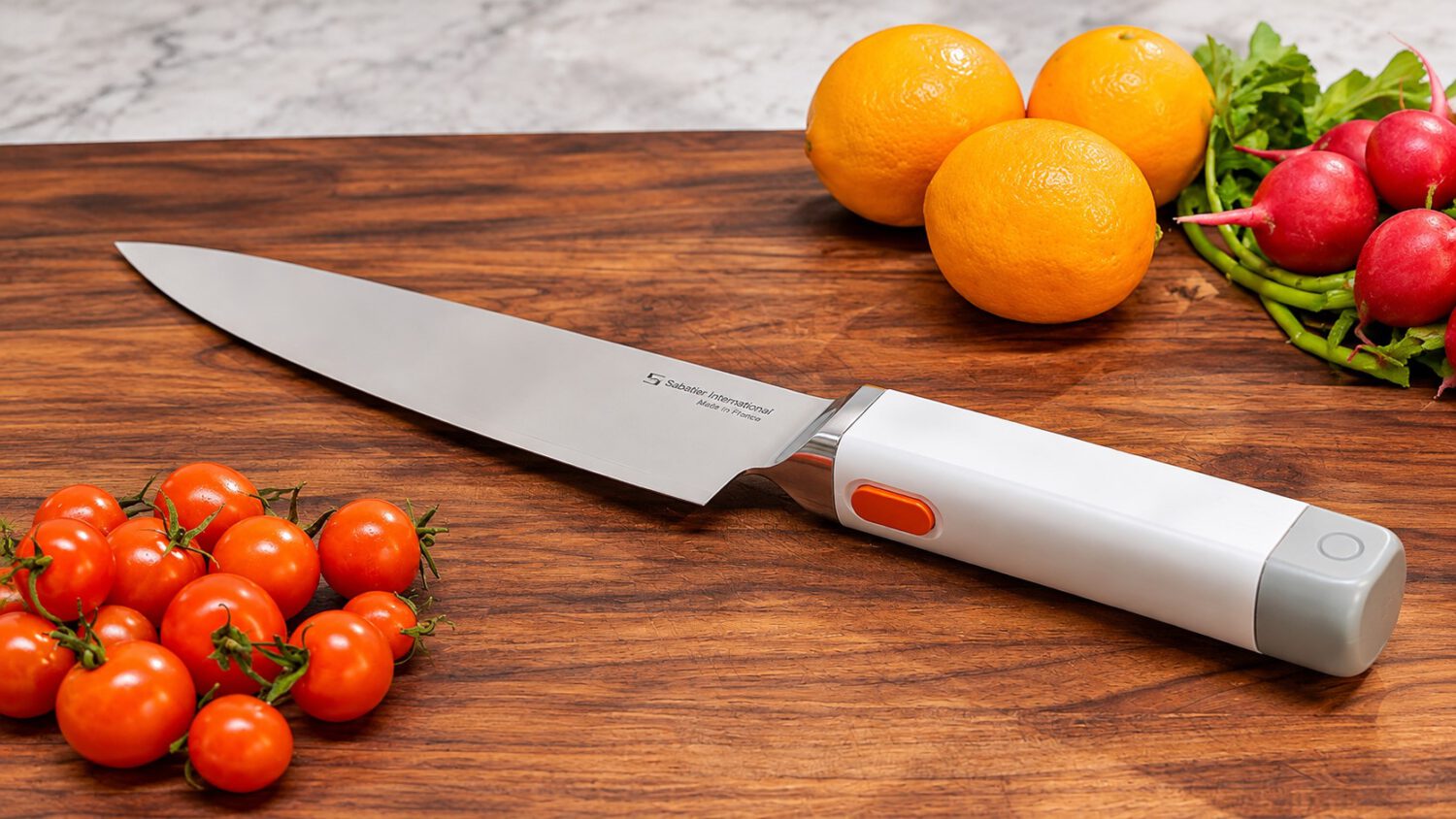
A tomato that crushes under a drag-heavy blade is one of cooking’s minor humiliations. Seattle Ultrasonics is betting $399 that its C-200 can end that particular frustration, joining a growing field of smart kitchen gadgets redefining how home cooks work.
The company debuted the C-200 at CES 2026, marketing it as the world’s first ultrasonic chef’s knife designed specifically for home cooks. The concept draws on technology associated with industrial ultrasonic cutting systems, compressed into a rechargeable, hand-held format that looks, and largely functions, like a conventional Japanese chef’s knife.
How the Ultrasonic System Works
The C-200’s blade vibrates invisibly at high frequency, with the manufacturer claiming up to half the cutting effort of a conventional knife.
When activated, the blade vibrates at more than 30,000 cycles per second. According to Seattle Ultrasonics, the operating vibration is not normally felt, heard, or seen through the handle, though at least one report noted a sound when the knife was used while wet.
Seattle Ultrasonics claims the powered mode can reduce cutting force by up to 50 percent, a figure the company attributes to its own testing. That “up to” qualifier matters: it represents a maximum under controlled conditions, not a consistent result across every ingredient or cutting technique.
Switch the system off and the knife operates as a standard chef’s knife. If the battery runs out, the knife can still be used manually while the ultrasonic function is unavailable.
 Image: Seattle UltrasonicsBlade, Battery, and Real-World Performance
The C-200 is built from Japanese AUS-10 steel, charges via USB-C, and performs most noticeably on foods that tend to stick or compress under a conventional blade.
The blade is 8 inches of Japanese AUS-10 steel hardened to 60 HRC. AUS-10 at 60 HRC represents a concrete premium specification, though blade steel and hardness alone do not determine overall knife quality.
Power comes from a removable 1,100 mAh lithium-ion battery charged via USB-C, with an optional wireless charging tile available as an accessory. Seattle Ultrasonics rates the knife at IP65 water resistance; hand washing is fine, but the dishwasher is not.
According to the manufacturer’s support documentation, the battery delivers roughly 20 minutes of continuous operation at maximum power, though real-world runtime will vary by use pattern. Independent coverage identified tomatoes and potatoes in particular, along with peppers and onions, as foods where reduced friction and improved food release are most apparent, though results for some ingredients were mixed across different reports.
Think of it less like switching to a sharper knife and more like improving the signal on a channel you already receive. According to Engadget’s testing, the advantage is considerably less meaningful for ingredients that already cut cleanly.
 Image: Seattle UltrasonicsPrice, Value, and Open Questions
At $399, the C-200 targets a specific type of cook rather than anyone who simply wants a reliable blade.
At approximately $399, the C-200 sits well above many conventional chef’s knives on the consumer market. The value proposition is specific rather than universal.
If you regularly work with sticky or soft ingredients, manage hand fatigue or reduced grip strength, or are drawn to experimental kitchen gadgets, the C-200 is built with your needs in mind. If you simply want a sharp, durable blade with no need for the powered function, the premium is hard to justify on current evidence.
Long-term durability of the ultrasonic electronics and actuator system requires broader ownership data than currently exists. Warranty terms and replacement-battery pricing details were not established in available sources.
Before committing $399 to a knife that requires charging, watch for independent long-term reliability reports. Those will clarify whether the C-200 holds up as a durable kitchen tool beyond its first-generation debut.