

Bouncers outside restaurants are an unusual sight, even in New York’s SoHo on a Saturday night. But at 59 Grand Street, they’re almost necessary. Once home to hospitality veteran Keith McNally’s iconic bistro, Lucky Strike, the address is now Straker’s (the first US outpost of London’s restaurant of the same name) which opened on October 10 and already has a waitlist of nearly 50,000.
This is the house that British chef Thomas Straker built, with butter as its bedrock. In 2020, his inventive flavored butters – from burnt chili to Café de Paris and miso-nori brown butter – drew fans worldwide. But it’s not just the immaculate quenelles that keep people watching. Straker’s swashbuckling cooking style, evoking a bygone era of bad-boy chefs, has made him a sensation. His videos preach the gospel of butter with rock-and-roll abandon, drawing viewers into the church of All Things Butter.
At the entrance, a ceramic vase painted like a pack of Lucky Strike cigarettes bears the words ‘Lucky Straker’s,’ a nod to both the cigarette brand and the restaurant’s former tenant. Inside, the room revolves around the kitchen, with bar seats offering prime views of chefs taming the live fire. Diners gather around the flames like clubgoers flock a DJ booth as music pumps through the room.
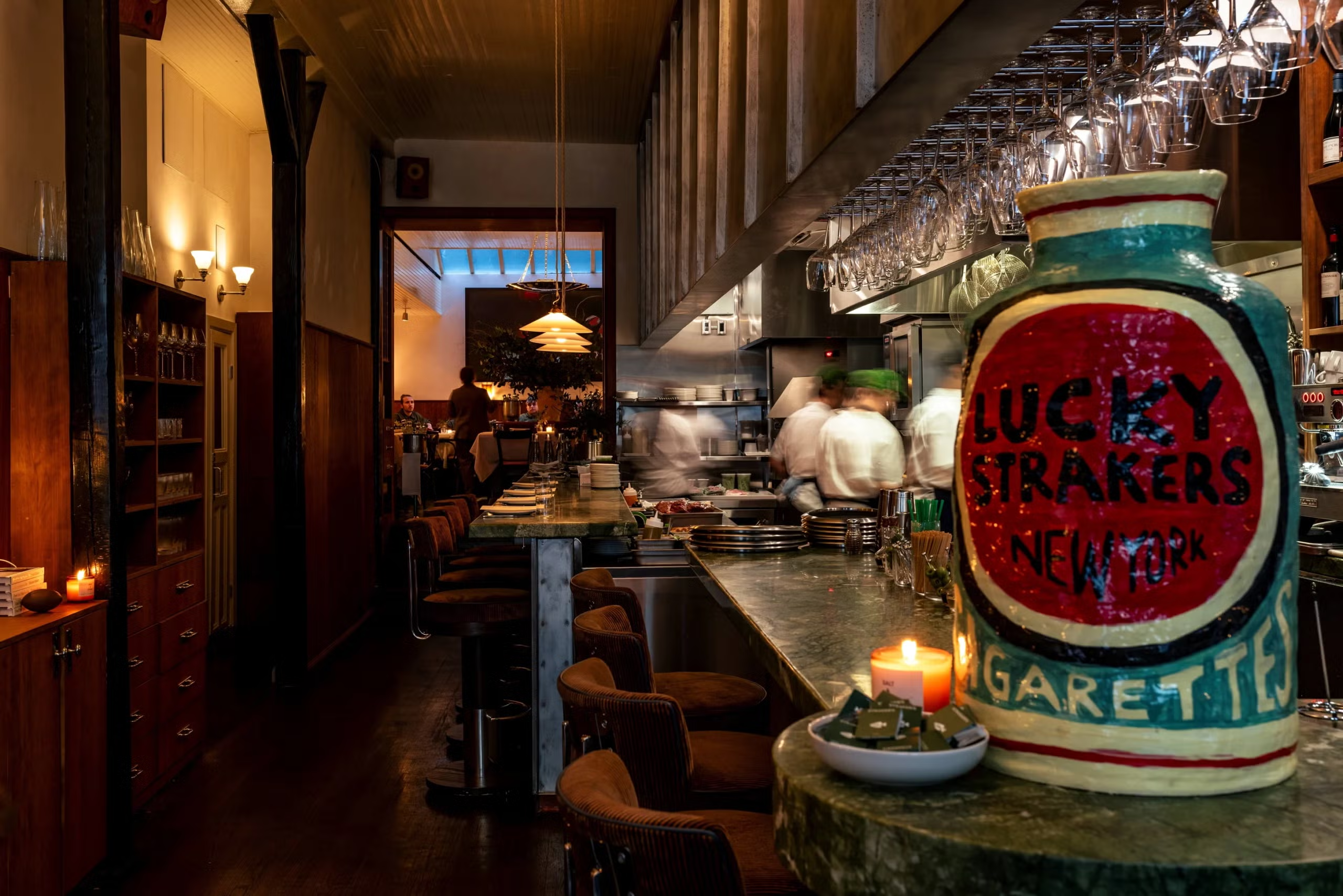 A ceramic vase fits on the bar as guests enter ©Thomas Streat
Yet the food is the antithesis of Straker’s brash persona: neat, precise, and deceptively simple, with few ingredients and little to hide behind. That restraint has roots in his childhood on a farm in Herefordshire, England, where he learned to hunt, butcher, and cook. He trained at London’s Dorchester Hotel before becoming chef de partie at Dinner, Heston Blumenthal’s restaurant at the Mandarin Oriental.
Straker went on to open his eponymous Notting Hill restaurant in 2022. In New York, Straker has largely kept his restaurant formula intact: dialled-up flavors and disciplined technique, with dishes that feel current without straying too far from their origins. The seafood is caught on this coast on the same day it’s served. Wood fire and seasonal produce do a great deal of work, but as does butter.


The burnt chili and mussel butter flatbread lands on every table, carried by servers in chore coats. Sweet, plump mussels offset the charred crust, its 48-hour cold-fermented dough lending a faint tang, and generous lashings of butter gloss each mussel. The rest of the menu follows suit, with dishes Straker apparently enjoys eating himself: Lucky Lime oysters with a lip-puckering vinaigrette, a two-biter Jonah crab and potato galette, and a tostada with red shrimp and foie gras. Butter, naturally, runs through the rest of the menu: langoustines with gremolata and brown butter; agnolotti with ricotta and burnt tomato butter; wood-roasted Dover sole with herb and lemon butter.
Much of the seafood comes from top purveyors along the East Coast, sourced the same day it’s served. Straker’s nods to institutional New York steakhouses with grilled strip steak and T-bone, both served with beef sauce, a distinctly English touch. The menu changes daily, though heavy hitters like the mussel flatbread remain fixtures. Wines span local and deep-cellar selections, with a tapered cocktail list offering riffs on classics.
 The 59-seat restaurant’s interiors were designed with Post Company ©Thomas Streat
Straker tapped Australian chef Luka Coyne, who has worked at New York restaurants including Soso’s and Tuxedo, for the role of head chef, who considers the transition a “very organic decision.”
“I was ready for the next step in my career, and Straker’s caught my attention early on,” Coyne says. He recalls a video chat with Straker and his kids running around in the background. “It just felt right,” he recounts. His favorite dish on the menu is the grilled lamb skewers with Nardello peppers and apricot hot sauce. “They’re smoky, sweet, savory, and spicy…just divine,” he says.
For the team, opening in New York was a different ballgame compared to opening in London, one that cost about four times as much. “Moving to New York is a massive move for the brand. It’s something that I’ve thought about for a long time,” Straker, who was born in Washington, DC, said in a statement. “I’m going to do everything to make sure that people have the best night of their lives when they come and eat with us.”
 Six drawings by Damien Hirst preside over the dining room ©Thomas Streat
The opening was delayed by 12 months and reportedly ran roughly $2m over budget, with a large sum going toward its artwork. Straker understood that a successful New York restaurant needed to speak to the city’s cultural literati, so worked with art agency Beaumont Nathan to find one-of-a-kind pieces.
Six drawings by Damien Hirst, including a blueprint for his controversial 1991 shark preserved in formaldehyde, preside over the dining room. Near the bar hang two works by Keith Haring: portraits of Marilyn Monroe and Elvis Presley. The 59-seat restaurant’s interiors, designed with Post Company, center on an open kitchen framed by green countertops and white tablecloths, and bathrooms are clad floor to ceiling in marble and mirror.
The restaurant might be occupying a storied location, but Straker and McNally share more than British roots and address. Both have a distinctly British brand of humor, and both understand that a restaurant’s atmosphere matters as much as what guests are eating. McNally walks into the room and is promptly seated – his third visit since opening.
For all its novelty, Straker’s feels less like an import than a native New York institution in the making. Its high-octane energy recalls an era when restaurants doubled as cultural destinations. At McNally’s former haunt, the unruly glamour of 1980s downtown dining feels newly alive, if only for the length of a meal.


