
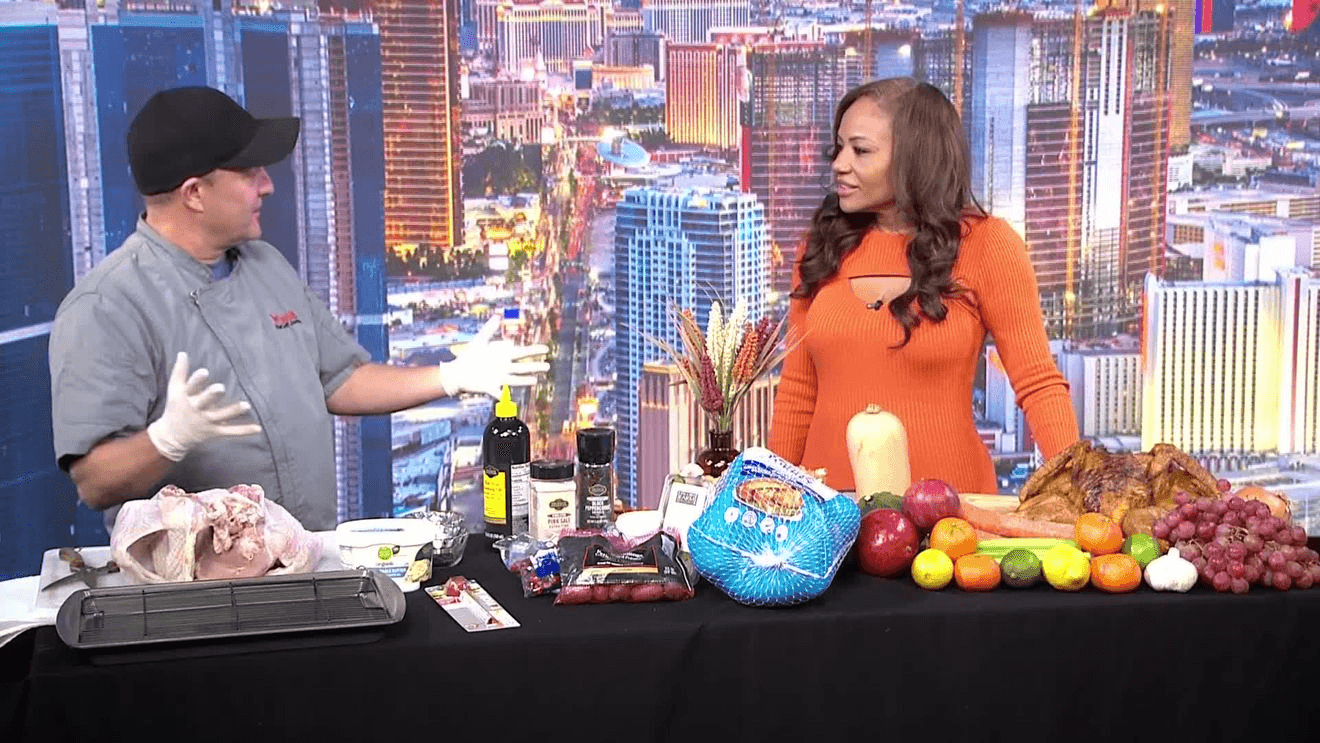
LAS VEGAS (KSNV) — With Thanksgiving just a couple of days away, home cooks who are nervous about tackling the turkey can take a breath — Chef Jeff with Smith’s says a flavorful, juicy bird comes down to smart preparation and trusting a thermometer.
Here are some tips from Chef Jeff:
1. Thaw safely. Thaw in the refrigerator at 40F or below, allowing about 24 hours for every 4–5 pounds. Set the wrapped turkey on a rimmed tray on the bottom shelf. Once thawed, cook within 1–2 days. Never thaw it on the counter.
2. Keep wet brining simple. Salt is the secret to a juicy, well-seasoned turkey; sugar adds a touch of sweetness and helps browning. For each gallon of cold water, dissolve 3/4 cup Diamond Crystal kosher salt (or 1/2 cup Morton kosher salt) and 1/2 cup sugar. Submerge the turkey and refrigerate at 40F or below for 12–24 hours. Discard the brine and pat the bird dry—no rinsing. Check the package first: skip this full-strength brine for self-basting, enhanced, or pre-salted birds. A partially frozen turkey may continue thawing in refrigerated brine, but do not assume an overnight soak will thaw a fully frozen large bird. Keep it cold and confirm it is fully thawed before using standard roasting times.
3. Dry and season the skin. Do not rinse raw turkey. Pat the skin dry with paper towels. For extra-crisp skin, refrigerate the turkey uncovered on a rack for 12–24 hours, safely separated from other foods. Rub softened butter under the breast skin and season the exterior with kosher salt and pepper, adjusting salt for pre-brined birds.
4. Add loose aromatics. Place onion, celery, carrot, apple, lemon, and fresh herbs loosely in the cavity for aroma. Do not pack it tightly. For best results, bake bread stuffing separately; stuffing cooked inside the bird must reach 165F in its center.
Roasting the turkey
5. Build a flavorful roasting bed. Heat the oven to 325F. Place the turkey breast-side up on a roasting rack or a bed of roughly chopped vegetables and apples in a sturdy roasting pan. Keep the pan drippings from scorching by adding a little water or unsalted broth if needed.
6. Roast uncovered, then protect the skin. Roast uncovered to encourage browning. If the skin becomes deep golden before the meat is done, tent the turkey loosely with foil. Avoid crowding the oven with other dishes.
7. Use time only as a guide. Turkey size, shape, oven performance, and whether the bird is stuffed all affect cooking time. Start checking the temperature before the estimated finish time; the thermometer, not the clock, determines doneness.
8. Check temperature in several places. Insert an instant-read thermometer into the thickest part of the breast, away from bone. Also check the innermost thigh and innermost wing. Take readings in multiple spots; do not rely on the pop-up timer alone.
Finishing and serving
9. Let carryover cooking finish the job. I like to remove the turkey when the thickest part of the breast reaches about 160F, then rest it for 25–30 minutes. The hot outer meat continues transferring heat inward, helping finish the bird without unnecessarily drying the breast. Check the temperature again during the rest: the breast, innermost thigh, and innermost wing must each reach 165F before serving. If any spot does not, return the turkey to the oven to finish cooking. Carryover is a technique—not a guaranteed five-degree rise.
10. Make the most of the drippings. Strain the flavorful pan juices and use them for gravy. Taste before adding salt, especially if the turkey was pre-brined.
11. Carve for juicy servings. Remove each breast half and slice it across the grain; separate the legs and thighs at their joints. Arrange on a warm platter and spoon over a little hot broth or gravy if desired.
12. Store leftovers promptly. Refrigerate turkey and stuffing within two hours of cooking. Divide large amounts into shallow containers for faster cooling. Use refrigerated leftovers within 3–4 days or freeze them.
Approximate roasting times
Fully thawed, unstuffed turkey at 325F. These are planning estimates, not doneness tests.
Turkey weight Estimated time
8–12 lb. 2 3/4–3 hours12–14 lb. 3–3 3/4 hours14–18 lb. 3 3/4–4 1/4 hours18–20 lb. 4 1/4–4 1/2 hours20–24 lb. 4 1/2–5 hours
“My most important tip: A good instant-read thermometer is your best friend,” Chef Jeff said. “Trust the temperature—not just the clock—and verify carryover cooking before carving.”
He cited food-safety guidance from the USDA Food Safety and Inspection Service, including safe thawing, poultry cooking temperatures and leftover storage.