
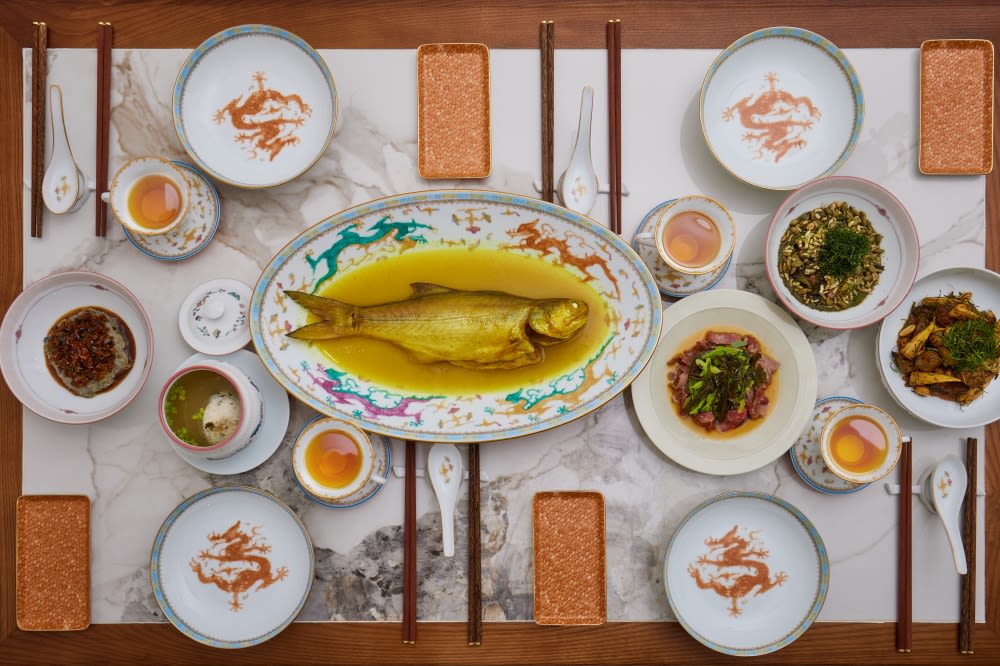
GEORGE TOWN, Sep 6 — Root House by gēn opened this year inside the newly restored 1926 Heritage Hotel on Jalan Burma, the latest restaurant from chef Johnson Wong following gēn and Communal Table by gēn.
The recipient of the Michelin Guide Kuala Lumpur and Penang 2024 Young Chef Award, Wong built his name by spotlighting Penang produce at his fine-dining flagship, gēn.
Root House takes the same produce and explores it through a distinctly Malaysian-Chinese lens, spread across the dialect groups that shape it: Hokkien, Fuzhou, Cantonese, Teochew, Hakka and Hainanese.
Wong is careful about how that premise gets described, though. “We’re not trying to trace old recipes,” he says. “We are researching them, looking at how they changed when they arrived in Malaysia, and why the food we know today is the way it is.”

Chef Johnson Wong (right) with the head chef of Root House, Chef Koh Chin Hong (left). Both are natives of Johor. — Picture courtesy of Root House by gēn
Chef Johnson Wong (right) with the head chef of Root House, Chef Koh Chin Hong (left). Both are natives of Johor. — Picture courtesy of Root House by gēn
The idea took shape after a post-pandemic trip to China. “I was very impressed by the level of cooking — not just in fine dining, but at every level,” he says. “It gave me a lot of ideas to create something of my own like that.”
Even gēn, he admits, still falls into convention. “We’ve focused on local produce throughout the years at gēn, but if you go deep down, Western fundamentals are still at the core. We wanted to do something different, with Chinese soul and technique but with a modern approach.”
Steamed fish, ubiquitous throughout Malaysian-Chinese restaurants, is the example he uses when describing the change between the food he found in China and the food he grew up with.
“We tend to use soy sauce because it’s the easiest way to bring out umami in seafood, but there are many other ways to achieve the same thing that we don’t see here often,” he says.
“One thing I saw there was an old Cantonese technique that uses chicken fat to get that flavour, but cleaner.”

Root House is located in the newly restored colonial-style 1926 Heritage Hotel. — Picture courtesy of Root House by gēn
Root House is located in the newly restored colonial-style 1926 Heritage Hotel. — Picture courtesy of Root House by gēn
A native of Johor, he traces the difference back to necessity. “Because we arrived in Malaysia as immigrants, a lot of the recipes and cooking techniques were simplified with shortcuts, adding stuff like sugar or cornstarch to make things tastier.
“I can’t say it’s a bad thing, but we just wanted to understand the reason behind it and how we can evolve it heading into the future.”
He points at sugar as an example. “I think when Malaysians eat Chinese food, we tend to have a sweeter palate, having become accustomed to a lot of added sugar.”
At Root House, that sweetness gives way to something purer — the signature threadfin is steamed with curry-infused chicken fat instead of soy.
Less sauce, and more of what he calls the ingredient’s “original flavour”, but with curry as the nod to Malaysia.
“What impressed me the most during my time in China was how light the Cantonese cuisine was, yet still elegant and sophisticated, and you can truly taste the original flavour of the ingredients,” he says.
“We’re inspired by the methods and want to incorporate them in a way that makes sense for Malaysia.”
While he is aware that “most Chinese food in Malaysia has been dominated by Cantonese cuisine”, Wong also sees that the Malaysian Chinese experience isn’t a monolith.

Classic dishes, like coconut and silkie chicken soup, receive an injection of Penang produce with the inclusion of kulim (left), while ‘lei cha’ is reimagined with ‘wosun’, also known as celtuce. — Picture courtesy of Root House by gēn
Classic dishes, like coconut and silkie chicken soup, receive an injection of Penang produce with the inclusion of kulim (left), while ‘lei cha’ is reimagined with ‘wosun’, also known as celtuce. — Picture courtesy of Root House by gēn
It’s true across dialect groups, but also true within. He points out that the cuisine of Hakka communities in the North and the South of peninsular Malaysia varies, and so too does Fuzhou cuisine, depending on whether they settled in Sitiawan or Sibu.
“An example is lei cha. The herb mixture varies from place to place because some herbs, like mint, are more bitter in some places than others. We just try to make sure that we study it as widely as possible.”
Three months in, Wong says the response to Root House has split down the middle. “We get very polarising feedback,” he says.
“It’s not right or wrong; people here have been eating Chinese food for many years, so they’re used to one variation of Chinese food. It’s not the Chinese food they’re used to, but it’s what we are trying to introduce to Penang.”
Root House is part of the new wave of produce-driven, heritage-centred restaurants emerging across Malaysia, most of which are a hit with tourists.
In Penang, Wong’s other two restaurants arguably fit the bill. “gēn is still the mother. It all goes back to why I returned to Malaysia in the first place — I was interested in learning about Malaysian produce. Root House is the expression of my love for Chinese cooking,” he says.
“Here, we want to have more locals, because the idea is to introduce Chinese food done differently to them, to show that the cuisine can evolve. I understand preserving culture and tradition is very important. But we shouldn’t be stuck to it.
“We are ingredient-forward, but we don’t use premium ingredients in the way Chinese restaurants tend to. If we use an ingredient, we want to find a good reason for it. Some old-school chefs cannot accept it,” he says.
“But I believe there’s no right or wrong way; it’s just about what we want to achieve. For us, we remain produce-driven, same as at gēn, just expressed in a different way.”
What he does want is for people to keep talking after the plates are cleared. “We are very happy when we see diners linger at the table, deep in conversation about our dishes,” he says.
“It can be good or bad, discussing preferences, but that’s what we want to see. We don’t want people to just sit down, eat and then leave.”
There’s a process to it, he says, but the process cannot be the point. “Ultimately, making something good that makes your customer happy is what matters. If you’re just cooking for yourself, I don’t see the point.”
Root House by gēn
1926 Heritage Hotel,
George Town, Penang.
Open daily, 12-3pm, 5-11pm
Tel: 012-827 1926
https://www.roothousebygen.com/
Facebook: Root House by Gen
Instagram: @roothousebygen
*Follow us on Instagram @eatdrinkmm for more food gems.
*Follow Ethan Lau on Instagram @eatenlau for more in-depth conversations.


